
Criminal Court Records in Lincoln County
A Lincoln County criminal court record begins the moment the District Attorney files a charging document called an "Information." From that point the Court Clerk opens a case, gives it a number, and keeps every filing in one permanent file. The Court Clerk for Lincoln County maintains these District Court records through the criminal division, and the office files orders, dockets each hearing, and stores the documents tied to the case. The Lincoln County record is the official memory of the case. It does not vanish when the case ends, and it stays open to the public under state law.
Criminal cases in Lincoln County are tried in the District Court, the general trial court for the county. The District Court hears both felony and misdemeanor matters. Felony cases carry a CF prefix, such as CF-2025-63, while misdemeanor cases carry a CM prefix, such as CM-2026-425. City ordinance offenses are different and route to a municipal court like Stroud rather than the county District Court. For the charges themselves and how they are filed, the Lincoln County court charge records page goes deeper, and the broader Lincoln County court records page covers every case type.
How to Search Lincoln County Criminal Court Records
Two official portals carry Lincoln County District Court cases. On Demand Court Records, known as ODCR, and the Oklahoma State Courts Network, known as OSCN, both let the public search felony and misdemeanor files for free. The Court Clerk page links both. Check each one, because the two systems display Lincoln County documents and dockets in slightly different ways.
- Open ODCR and choose Oklahoma District Courts, then select Lincoln to narrow the search to the county.
- Enter the defendant name in last name, first name order, or type a full case number if you have one.
- Narrow by type of case, such as Criminal Felony or Criminal Misdemeanor, and add a filing date range when the name is common.
- Open the case to read the header, the charges, the docket entries, and the disposition.
- Request a certified copy from the Lincoln County Court Clerk when a docket entry says the document is only available at the Court Clerk's Office.
The OSCN docket search is the second stop. Pick Lincoln County District Court in the county dropdown and enter the exact case number, such as CF-2014-1. OSCN also runs District Court reports, like a daily docket by judge, that help when you do not yet have a name or number. For sentenced state prisoners, the Oklahoma Department of Corrections offender lookup tracks custody after a District Court case closes.
Stages of a Lincoln County Criminal Case
A Lincoln County criminal case moves through set stages, and each one leaves a mark in the file. Charges come first, filed by District 23 District Attorney Adam Panter through an Information that names each count and its statute. The defendant then appears for arraignment, enters a plea, and the case heads toward either a negotiated plea or a trial. Every step is dated and coded in the docket, so the record reads as a timeline.
Case flow: Charges Filed › Arraignment › Pretrial / Motions › Plea or Trial › Disposition › Sentencing
| Stage | What Happens |
|---|---|
| Arraignment | The judge reads the charges, the defendant enters a plea of guilty, not guilty, or no contest, and the court sets bond and the next hearing. |
| Pretrial / Motions | Lawyers file motions, exchange evidence, and argue legal issues. Continuances, bond changes, and counsel entries all show here. |
| Plea or Trial | Most cases end in a plea agreement entered on the record. The rest go to a judge or jury trial that returns a verdict. |
| Sentencing | After a guilty plea or guilty verdict, the judge imposes the sentence, sets fines and costs, and fixes any probation terms. |
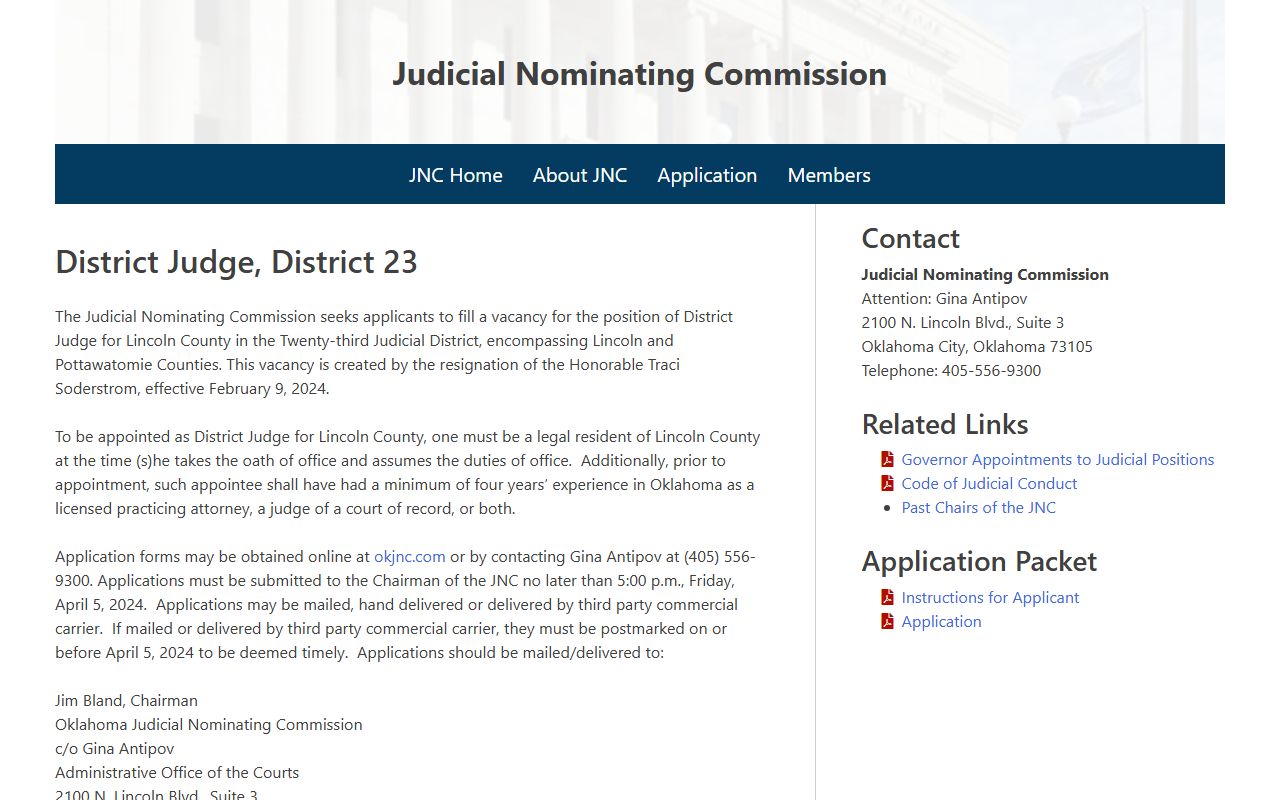
District 23 covers Lincoln County along with Pottawatomie County, and Sarah Bridge serves as the District Judge who hears these cases. The judge who handled a matter is named in the case header or in the docket text. The Judicial Nominating Commission page for the District 23 judgeship lists the applicants and nominees considered for the Lincoln County bench. That public process is a reminder that the judge named in a criminal court record is a known, accountable official whose rulings shape the file.
What a Lincoln County Criminal Court Record Shows
Open a Lincoln County criminal case and the header loads first. It names the court, the Lincoln County venue, the case number, the case style, the filing date, the assigned judge, and the case status. Criminal files use the style "State of Oklahoma v. Defendant." Below the header sit the parties, the attorneys, the charges, the docket entries, and the financial ledger. The table below breaks down the core fields you will read in almost every felony or misdemeanor file.
| Field | What It Shows |
|---|---|
| Case Number | A prefix, year, and sequence such as CF-2025-63 for a felony or CM-2026-425 for a misdemeanor. |
| Defendant | The person charged, listed opposite the State of Oklahoma as the named party in the case style. |
| Charges | Count-numbered "Information" entries naming each offense and the statute the District Attorney cites. |
| Plea | The defendant's response, entered as guilty, not guilty, or no contest at arraignment or later. |
| Disposition | The final outcome of each count, such as convicted, dismissed, acquitted, or deferred. |
| Sentence | The punishment after a conviction, including jail or prison time, probation, fines, and restitution. |
Docket entries carry their own structure. Each line in a Lincoln County file shows a date, a code, a description, a count, a party, and an amount. Codes seen in these files include INFORMATION for the charge, AFPC for a probable cause affidavit, and REST for restitution. The financial side lists court costs, bond fees, sheriff service fees, the jail fund, a victim compensation assessment, a CLEET fee, and a District Attorney Council assessment. Documents either appear as TIFF or PDF links or carry a note that the paper is held at the Court Clerk's Office.
Charges vs. Convictions
A charge is an accusation, not proof of guilt. A Lincoln County criminal court record can list counts that were later dropped, dismissed, or sent to an acquittal at trial. Reading the disposition for each count is the only way to know how a case ended. Treating a charge as a conviction is a common and serious mistake, since the two sit at very different points in the case.
| Charge | Conviction | |
|---|---|---|
| Stage | Accusation filed by the District Attorney | Verdict or guilty plea entered on the record |
| Burden of Proof | Probable cause | Beyond a reasonable doubt |
| Outcome Possible | May be reduced, amended, or dismissed | Carries a sentence and a criminal record |
| Public Record | Yes | Yes |
One outcome sits in the middle. A deferred judgment delays a conviction while the defendant meets court conditions, and a clean record at the end can let the charge close without a formal conviction. If conditions are broken, the State can file to accelerate the sentence. The Lincoln County docket shows both the deferral and any acceleration, so the final entries tell the real story.
Reading Lincoln County Dispositions and Sentences
The disposition is the bottom line of each count in a Lincoln County case. Common results in these criminal files include guilty, not guilty, dismissed, and a plea of nolo contendere, which means no contest. A dismissal may be with prejudice, meaning the count cannot be refiled, or without prejudice, meaning it can. The sentence follows a conviction and spells out the punishment in plain terms within the docket text.
Sentences in a Lincoln County case can mix several parts. A defendant might receive jail or prison time, a suspended sentence, probation under court supervision, fines, court costs, and restitution to a victim. When prison time is imposed, custody shifts from the county to the state. The Oklahoma Department of Corrections offender lookup then becomes the place to confirm where a sentenced person is held and the status of their supervision.
Reading the financial entries matters as much as the punishment. A Lincoln County criminal record lists each Lincoln County fine, fee, and assessment along with payments and receipts, so a balance can stay open long after the sentence is handed down. The Oklahoma Department of Corrections offender lookup warns that its data covers state custody, not county jail holds, which keeps the two record systems clearly separated.
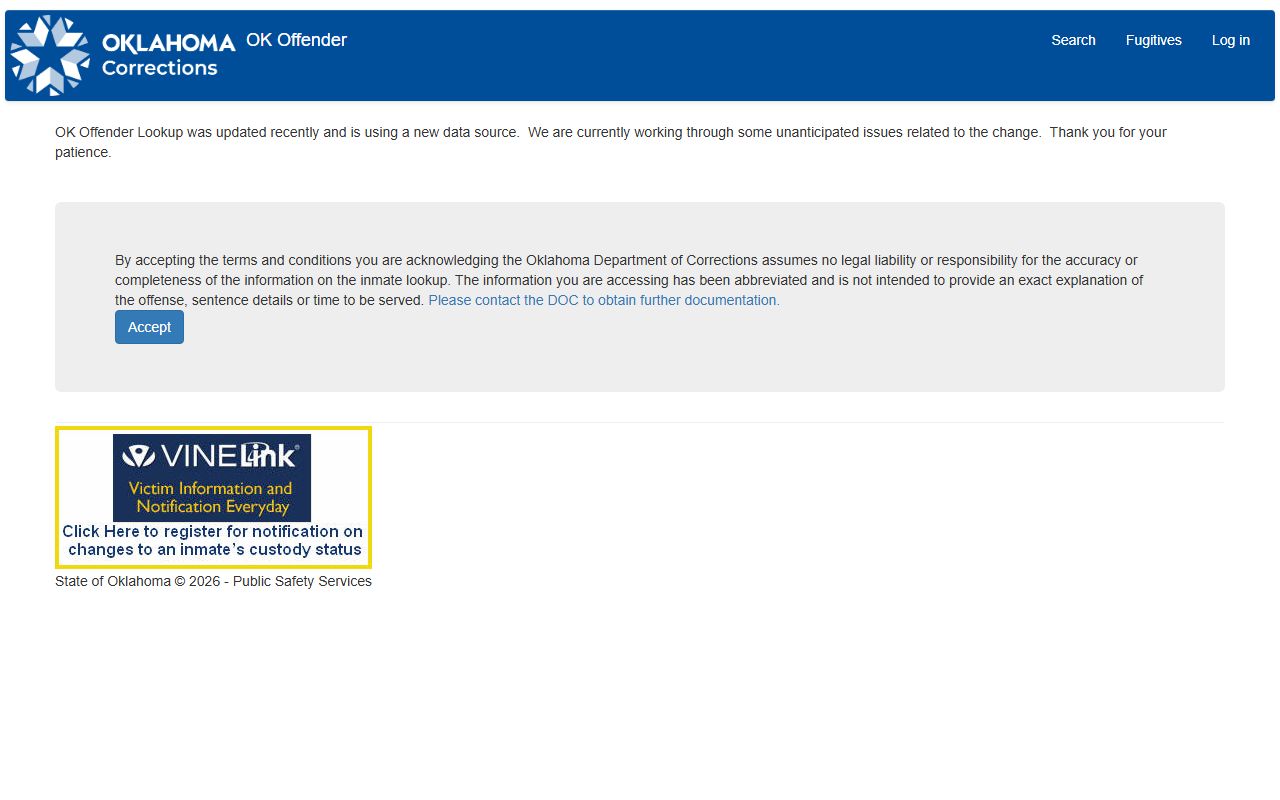
Note: A sentence on the docket and a custody listing are two separate records, so confirm time served and release status with the state corrections system, not the court file.
Sealed vs. Expunged Records
Some Lincoln County criminal records are removed from public view through a court order. Oklahoma law treats sealing and expungement as related but distinct outcomes, and the difference changes who can still see a Lincoln County file. Neither one is automatic. A person has to petition the District Court and meet the conditions the statute sets before any record comes down.
| Sealed | Expunged | |
|---|---|---|
| Visibility | Hidden from public search results | Treated as though the record never existed |
| Law Enforcement | Limited access remains | Very limited access |
| Eligibility | Set by 22 O.S. Section 18 for qualifying arrests and cases | Granted under the procedure in 22 O.S. Section 19 |
The process runs through the same court that holds the case. The person identifies whether the arrest, charge, deferred sentence, or acquittal fits the statute, files the petition, and serves notice on the agencies that keep the record, such as the Court Clerk, the District Attorney, and the arresting agency. If the judge grants relief, the order directs those offices to seal or remove the public record. Public searches may then return no result even when a case once existed.
Public Access to Lincoln County Criminal Court Records
Criminal case files in Lincoln County are public by default. The Oklahoma Open Records Act treats Lincoln County District Court records as open unless a specific law makes a file confidential. That open-access rule is why ODCR and OSCN can post felony and misdemeanor dockets without a login. When an online entry stops short, the next step is the office that owns the record, which for Lincoln County criminal cases is the Court Clerk.
Key Statutes:
Oklahoma Statutes Title 51 § 24A.1 - the Open Records Act requires public bodies to give access to records unless a law makes them confidential.
Oklahoma Statutes Title 22 § 18 - sets who may seek to seal or expunge qualifying arrest and criminal records.
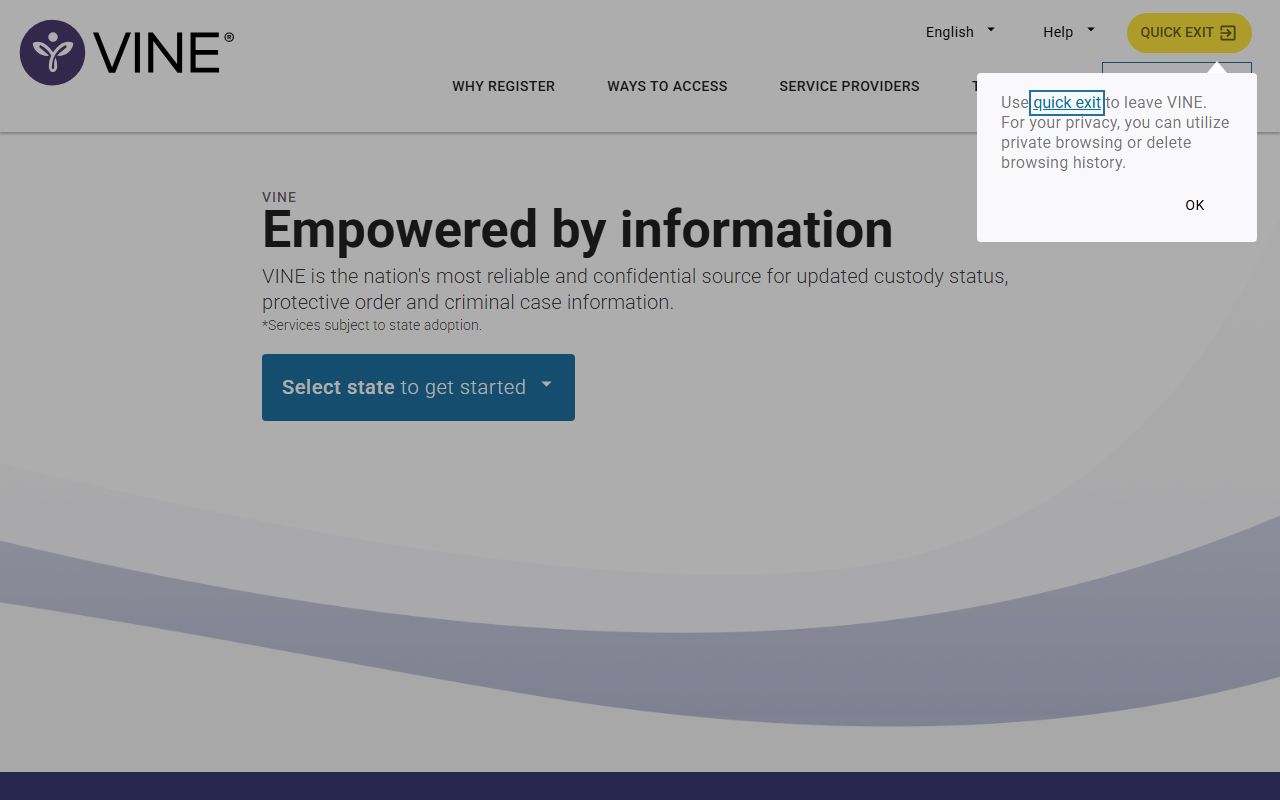
Crime victims and the public can also follow a defendant's custody status outside the court file. The state-linked notification service lets a person register for alerts when an inmate is released or moved. The VINELink notification system ties into Oklahoma jail and victim services, and it gives families a free way to stay informed without watching the docket day to day.
Background Check Considerations
A casual look at a Lincoln County criminal court record is not the same as a regulated background check. Reading a public docket on ODCR or OSCN is open to anyone. Using that information to decide on hiring, housing, credit, or insurance falls under the federal Fair Credit Reporting Act, which sets accuracy and consent rules that court portals do not provide. For those decisions, a licensed screening company is the proper channel.
Important: This site is not a consumer reporting agency under the FCRA, and its information may not be used for employment, tenant, credit, or insurance screening.
Restricted Lincoln County Criminal Court Records
Not every Lincoln County criminal matter shows up in a public search. In Lincoln County, juvenile and youthful offender cases are generally restricted under state law, so a missing online entry does not mean no case exists. Sealed and expunged cases drop out of public results once a judge signs the order. Ongoing investigations, search warrant materials before execution, and certain victim or identifying details may also be withheld or redacted.
When a record is restricted, the path forward runs through the Court Clerk or, for arrest and booking paperwork, the Lincoln County Sheriff's Records Division. The Court Clerk can confirm whether a file exists, whether it is sealed, and what a person needs to request a copy. For active custody and bench warrant questions tied to a criminal case, the Lincoln County warrant records page lays out the sheriff and court channels in more detail.